Injury management: from day one to return to play
An injury involves at least three people: the physio who treats it, the fitness coach who prepares the return, the head coach who needs to know when the player is available. If the information lives in three places, return to play is decided by word of mouth. Here is how to keep it together.
What to record on day one
- Date and context: training or match, minute, drill, contact or not.
- Body area and side: better on a body map than in words, so everyone reads the same thing.
- Type: muscle, joint, contusion, tendon, other.
- Pain: VAS scale from 0 to 10, repeated at every check.
- Estimated time out: indicative and to be updated. It helps the coach plan; it isn’t a promise.
You don’t need a medical record: diagnosis stays with the doctor. The staff needs to know what happened, where, and until when the player is unavailable.
Following the progress
Every check is a dated update: pain, what the player did (therapy, gym, running, pitch), what changes in the estimate. Lined up, the updates become the injury timeline, and at the end of the season they show how long returns really took compared with the estimates.
Keep the player’s status separate from the diagnosis, because status is what the coach looks at. Three are enough: unavailable, in rehab (working apart or partly with the group), available.
Return to play is a staff decision
Return to play isn’t a date, it’s a sequence of steps. A typical progression:
- Gym work, pain-free in daily activities.
- Straight-line running, then changes of direction.
- Partial return with the group, no contact.
- Full session with the group.
- Available for selection.
Each step is passed when the staff agrees, with the data in front of them: pain, tests completed, load sustained in the previous days. Load matters: a player out for three weeks who comes back to a full week makes a huge load jump even if they “feel fine”.
Reading injuries at team level
At the end of each month or half of the season, it’s worth looking at how many days were lost, where (body areas that repeat), when (pre-season, after a break, double-match weeks) and how (contact or not). It isn’t statistics for a report: it’s how you notice that hamstring strains all arrive in the same week of the month.
How you do it in dropseet
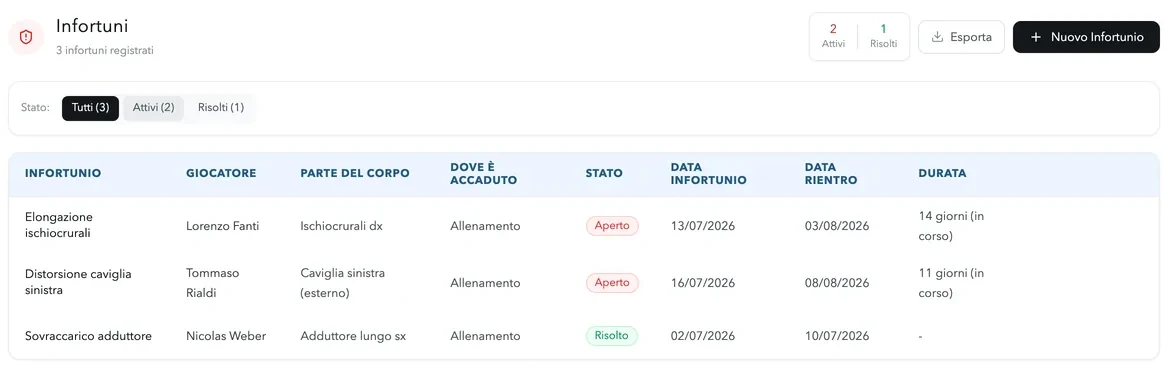
In dropseet an injury is opened with area and side on the body map, pain and estimated time out; every check is an update on its timeline. If a player gets hurt during a match, the injury is created right there as “to assess”, and the player stays unavailable until the medical staff closes it. Coaches see who is available without asking, the medical staff sees the load the player is carrying, and the team summary shows days lost and the most affected areas.
Frequently asked questions
Who should update the injury?
Whoever is treating it, usually the physio or the doctor. What matters is that the coach never has to ask: they should see the updated status on their own.
How much clinical detail is needed?
What the staff needs to work: area, type, pain, estimate, return-to-play steps. Reports and scans stay in the doctor’s channels.
How are days lost counted?
From the day of the injury to the day the player is available again for full training and matches. Counting them the same way every time lets you compare seasons.