Training load with RPE: how to measure it and use it
Internal load starts with the simplest question you can ask a player after training: “how hard was that?”. Collected every day and multiplied by minutes, it becomes the number that tells you whether the week is climbing too fast. Here is how to do it, with no equipment.
What session RPE is
RPE (Rating of Perceived Exertion) is how hard the player says the session felt, on a scale. The most common one in football is CR-10, from 0 (rest) to 10 (maximal effort); some staffs use the 0–100 version for more detail.
The session-RPE method (Foster, 2001) multiplies that score by the duration in minutes. The result is expressed in arbitrary units (AU):
session load = RPE × minutes
A 75-minute session rated 6 is 450 AU. A 95-minute match rated 8 is 760 AU. No GPS, no heart-rate monitor: you just need to ask everyone, every day, the same way.
How to collect it without losing data
- Ask 20–30 minutes after the end, not right after the last drill: straight away, the score only reflects the final effort.
- One player at a time, out of earshot. If the captain says 4, the group says 4.
- Always use the same question (“how hard was the session?”) and show the scale with words, not just numbers.
- Record the real duration, not the planned one, and separate players who did modified work.
- Count matches and active recovery too. A gap in the data lowers the average and makes the following week look like a spike.
From one session to the week
The useful number is not the session, it is the weekly total. A sample microcycle with a Sunday match:
| Day | Minutes | RPE | Load (AU) |
|---|---|---|---|
| Monday | 60 | 4 | 240 |
| Tuesday | 75 | 6 | 450 |
| Wednesday | 90 | 7 | 630 |
| Thursday | 60 | 5 | 300 |
| Friday | 45 | 3 | 135 |
| Saturday | — | — | 0 |
| Sunday (match) | 95 | 8 | 760 |
| Week | 2,515 |
Two things come out of this: how heavy the week is compared with previous ones, and whether the load is spread out or packed into a single day.
ACWR: acute versus chronic load
The ACWR (Acute:Chronic Workload Ratio) compares the last week’s load (acute) with the average of the last four (chronic). It shows jumps: the body copes well with the load it is used to, less so with load that arrives suddenly.
With the example week (2,515 AU) and the three previous weeks at 2,150, 2,300 and 2,400 AU, chronic load is 2,341 and the ACWR is 1.07: a normal week. Had the previous three been 1,600, 1,700 and 1,650, the same week would give 1.35: a jump to check player by player.
The literature often quotes a range of 0.8 to 1.3 as a safe zone. Use it as a prompt to ask a question, not as a traffic light: the ACWR doesn’t know whether the player slept badly or is coming back from injury. The value always comes from a staff reading it alongside everything else.
The most common mistakes
- Collecting it only when there is time. Load measured three days out of five isn’t load, it’s a sample.
- Team averages only. The group can sit at 1.05 with two players at 1.5: look at individuals.
- Forgetting players who don’t train. Injured and modified players must be recorded, or their return looks like a spike.
- One spreadsheet per month. Chronic load needs four continuous weeks: if the data lives in different files, nobody calculates it.
How you do it in dropseet
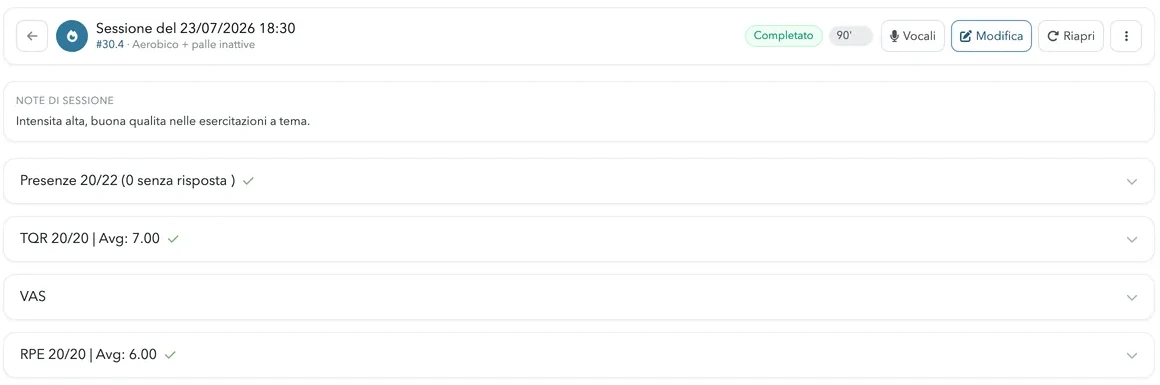
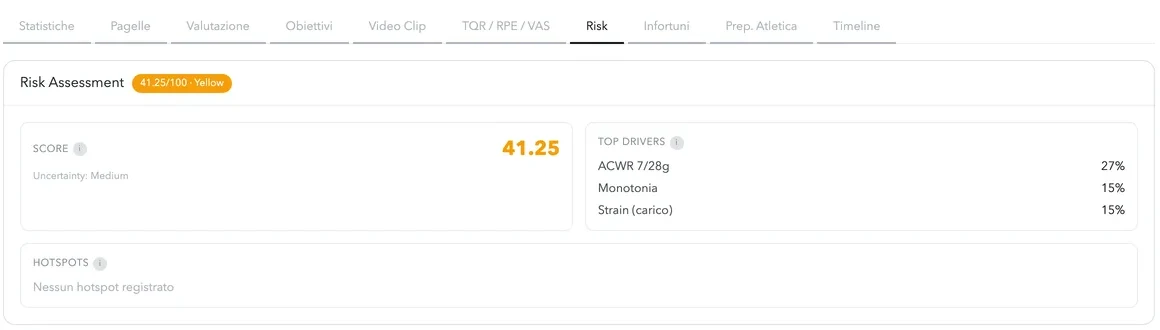
In dropseet each session already has its minutes and its attendance: RPE is entered per player right after training, from a phone too, and session load is calculated automatically. Weekly load and load jumps can be read on each player’s profile and at team level, next to attendance, wellness and injuries. You can also ask Vice, the staff assistant, “who had the biggest load jump this week?”.
Frequently asked questions
CR-10 or the 0–100 scale?
CR-10 is the most widespread and the easiest to explain to young players. 0–100 gives more detail with adult players used to it. Above all, don’t switch mid-season.
Does RPE work with youth teams?
Yes, from about 12–13 years old it works well if the scale has words next to the numbers. With younger kids, simplify it (easy, normal, hard) and focus on attendance more than load.
How many days of data does a reliable ACWR need?
At least four weeks of continuous data. Before that, chronic load is too short and every week looks like a jump.
Does internal load replace GPS?
No, it measures something else: GPS tells you how much the player ran, RPE how much it cost them. If RPE is all you have, you still have the most important number.