Training attendance: how to keep a register that works
Attendance is the simplest data there is, and the first to get lost: a sheet in the kit bag, a message in the group chat, a count done from memory at the end of the month. Yet it underpins everything else, from minutes played to squad selection.
Why attendance matters more than it seems
An attendance register answers three questions the staff asks every week: who is ready for the match, who is missing too much and why. In youth football it also matters for parents and the club; with senior teams it gives context to every load number: a player who missed two sessions cannot carry the same load as the others.
What to record beyond present and absent
A useful register has more than two states. The ones that really matter:
- Present: did the full session with the group.
- Partial / modified: was there but did different or reduced work.
- Injured: absent because of an injury already recorded.
- Ill: absent through illness.
- Excused: school, work, family, national team.
- Unexcused: absent without notice.
With these six options, a player’s 70% attendance stops being a number and becomes a story: three weeks of exams, or three absences without a word.
The percentages worth watching
- Attendance per player over the season and the last 4 weeks. The season shows who is consistent, the last weeks who is dropping off.
- Attendance by session type. Someone who always skips Tuesday conditioning is not the same as someone who misses at random.
- Consecutive unexcused absences. Two or three in a row is the moment to talk, not at the end of the month.
- Average team attendance by day. If there are always 14 of you on Friday, Friday should be planned for 14.
The spreadsheet problem
A spreadsheet works as long as one person keeps it. Then the fitness coach records modified work in another file, the physio has the injured list on WhatsApp, and by the end of the month nobody knows which column is right. The register needs to live where the session is created: if the session exists, the player list already exists, and marking who is missing takes a minute.
How you do it in dropseet
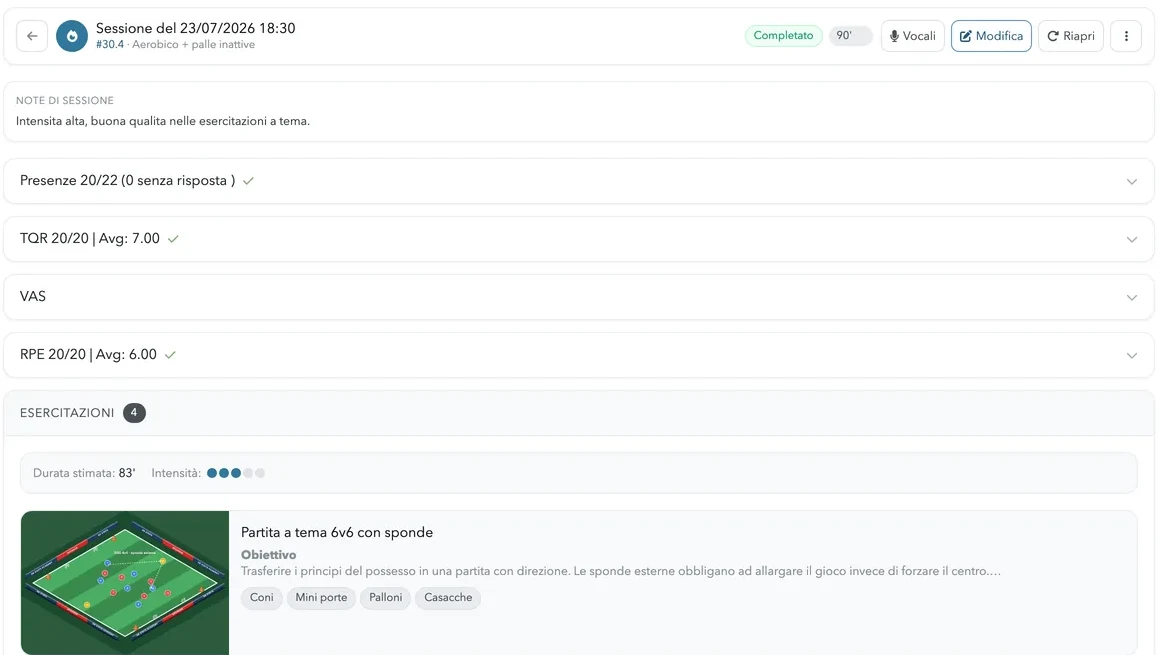
In dropseet, when you create a session the team’s player list is already in it: you only mark who is missing and why (injury, illness, school, no notice), even from the touchline. Percentages per player and per period update on their own and appear on each player’s profile, together with load and matches played.
Frequently asked questions
Who should keep the attendance register?
One person on the staff, always the same one, who closes it before leaving the pitch. Others add their part (modified work, injuries) in the same place, not in a separate file.
Should lateness be recorded?
If it matters in your team, yes, as a note on the attendance. It doesn’t need its own state: you just need to find it again when you talk to the player.
Is it worth keeping for the youngest age groups?
Yes, even more so: it’s the data the club and parents ask for, and the first sign that a child is losing interest.