Football player evaluation form: what to rate and how to use it
At the end of the season everyone can say who improved. Few can say in what, and by how much. That is what an evaluation form is for: four areas, a few items, one scale for everyone and three fixed points in the season. Here is how to set it up so the staff actually fills it in and the player understands it.
What it is for, and what it is not
An evaluation form captures the player’s level at one point in the season, item by item. Lined up with the previous ones, it shows the journey: what has improved, what is stuck, what to work on.
It is not the match rating: that judges one performance, the form judges growth. Keeping them apart stops one bad Sunday from outweighing three months of work.
The four areas and their items
Four areas are enough. Within each, 3–5 items the staff can genuinely observe:
| Area | Example items |
|---|---|
| Technical | directional control, passing, ball carrying, finishing, heading |
| Tactical | positioning, game reading, off-ball movement, defensive phase |
| Physical | speed, endurance, strength, agility |
| Mental | concentration, leadership, handling pressure |
Goalkeepers get an extra area of their own (handling, coming off the line, playing with the feet). With younger players you drop items, not areas: for an under-10, tactics is “knows where to stand when we have the ball”.
Scale and frequency
A 1–10 scale works from under-14 upwards; with younger players 1–5 is easier to explain. More than the scale, what matters is that every score means the same thing to the whole staff. Write it down once:
- 5: does it only in training, unopposed.
- 6: does it in matches, when given time.
- 7: does it in matches, under pressure too.
- 8: it is a strength, the team relies on it.
Three points in the season are the useful minimum: start, middle, end. Every 6–8 weeks is better, if the form is quick to fill in.
Who rates, and how to avoid identical scores
- More than one person. The coach and the fitness coach see different things: the average of two views is fairer than one.
- Matches and training. Rating only on Sundays rewards whoever starts.
- An example for any score far from the average. “Leadership 8: organises the back line by voice” is worth more than the number.
- Not all 6s and 7s. If a player has the same score everywhere, the form says nothing: find their strength and the thing to train.
Sharing it with the player and the family
The form works when the player sees it. One approach that also works with parents: two strengths and one goal for the next period, written so it can be trained (“directional control with the left foot”, not “improve technique”).
In youth football you compare the player with themselves, never with teammates. The goal then has to be followed up in sessions: if it stays on paper, the next form will look the same. Attendance helps read it: a player out for two months has not “got worse”.
How you do it in dropseet
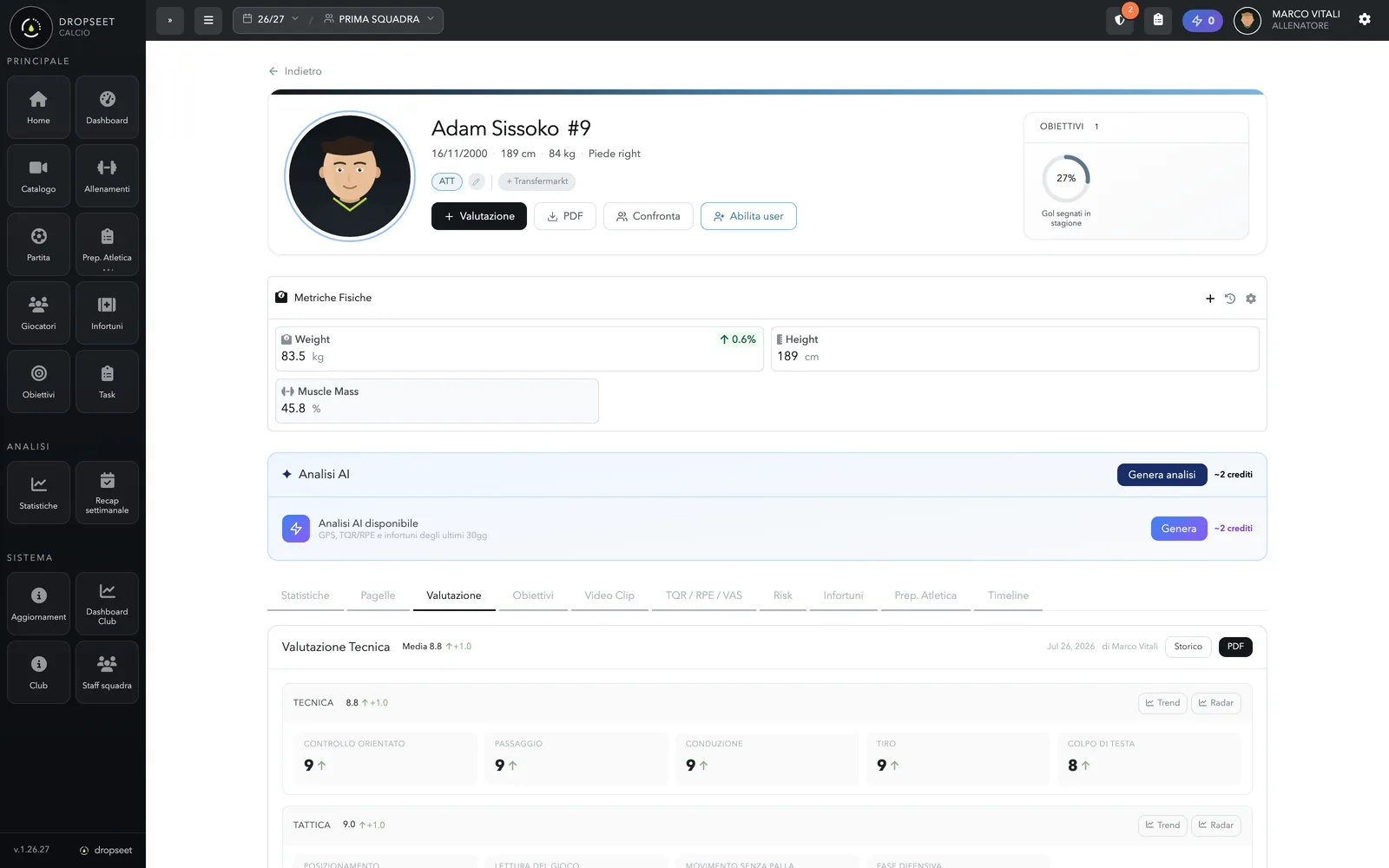
In dropseet the technical evaluation lives on the player’s profile, with areas and items set by the club. For each area you see the average and the change from the previous evaluation, the trend over time and the radar; the history keeps every form of the season and who filled it in. The evaluation exports to PDF for the player or the family, next to the player’s goals, match ratings and attendance. You can see it on a team already full of data in the demo.
Frequently asked questions
How often should you do a player evaluation?
At least three times a season: start, middle and end. Every 6–8 weeks if the staff can manage it: more often and it becomes a chore and the scores flatten out.
Should scores be 1 to 10 or 1 to 5?
1 to 10 from under-14 upwards, 1 to 5 with younger players. What matters more is that every score means the same thing to the whole staff.
Should parents see the evaluation form?
Yes, with two strengths and one goal for the next period. Comparing the player with themselves, never with teammates.
How is it different from a match rating?
A match rating judges one performance, the evaluation form judges growth over time. Keeping them apart stops one bad match from outweighing months of work.